Friday, May 03, 2013

Señales

Ruta de la Amistad

Station # 1
Señales - México


Ángela Gurría - 1929-


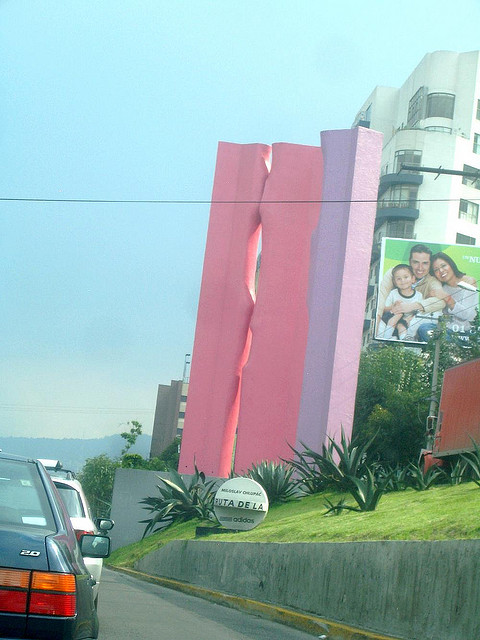
The first installation in the Route is a 18 meter high sculpture made up of two horn shapes colored black and white.  The colors alluded to the fact that the 1968 Olympics were the first to feature the broad participation of countries from Africa.  


This was the sculpture I saw most frequently, almost every Sunday when we went to my grandparents house.  It was placed on the overpass where we would get off the motorway.  Seeing it meant that we were close to our destination.  At the time, I did not know the name or the meaning of the sculpture, but I would try to figure it out.
Sometimes it looked like horns, at others it looked like teeth.  A few times I saw something resembling a bird.  I found it interesting how the sculpture looked very different depending on the angle you looked at it.  


\


Thursday, May 02, 2013

Ruta de la Amistad

In my last post, I recalled my journeys from my family's home to my grandparents' house on the other side of Mexico City.  I also have been reminiscing about my memories of the public art in Mexico.

As a child, I particularly liked driving to my aunt's house that was further south from my grandparents' house because we drove along la Ruta de la Amistad:  a large scale public art project along a 17 km route that followed the ring expressway along the southern perimeter of the city.  The project was part of the celebration of the 1968 Olympic games being held in Mexico City, where the notion of including a Cultural Olympiad along with the sporting one was put forth.  As part of the project, nineteen large artistic pieces designed and built by renown artist from around the world and measuring from 7 to 22 meters in height were placed along the route every one and a half kilometers.  These large sculptures were to be placed either on the lava beds or in the agricultural fields that are found in the area - this part of the city was not developed at that time.  Three other installations were to be placed at specific sporting venues, including the nearby Olympic Stadium and the Azteca Soccer Stadium.


When we would drive by these in the 1970s, the city had begun to expand into this area, but still seemed to be on the fringes of the urban center.  Nonetheless, I loved spotting each sculpture, seeing the small sphere that identified the country from which the artist came from, and trying to make sense of the abstract art.

Over time, these sculptures were neglected and were not cared for.  They were vandalized and eroded by the elements.  Recently, there have been efforts to restore them by having business, non-profit, and diplomatic entities "adopt" each and fund their rehabilitation.

Over then next few days I will be posting pictures of each and my memories of them.

Tuesday, April 30, 2013

Public Art and Private Architecture.

When I was two or so, my family (father, mother, and I) moved to Ciudad Satelite, a northwestern suburb of Mexico City (see the previous post).  The rest of my father's relatives lived in the southern suburbs of the city.  My grandparents lived in a upscale development development  built on the lava beds to the southwest of the city.  The area featured modernist architecture that was supposed to live in harmony with the landscape.  Gardens incorporated the lava beds rather than removing them (my grandparents' house certainly did - the lava rocks were great to climb on, but also left many a gash on my knees and elbows).  Houses featured large windows floor to ceiling windows that offered a direct connection with the nature outside.


However, most of the houses were surrounded by large and looming ivy covered walls that hid most of the architecture from any passers by.

Almost every Sunday, we made the trek from the north of the city to my grandparents' house for Sunday comida (a large meal somewhere between lunch and dinner) with the rest of the extended family.  The trip was marked by the recongnizable landscape and monuments we passed on the way.  These included the unfinished and abandoned bullfighting ring that was supposed to be covered, which marked the boundary between the State of Mexico and the Federal District,


the Central Military Hospital, the Oilworkers Fountain on an overpass,


the Chapultepec theme park with its giant rollercoaster that never worked,


Los Pinos (the President's residence), some random colonial churches,


a factory with a huge concrete smoke stack,


the Televisa (the only television network in Mexico) San Angel Studios, an AMC auto dealer with weird futuristic architecture, and then when we finally got off the motorway, the first of seventeen massive public art sculptures commissioned for the Olympics in 1968.  More on that later.

Once entering the development my grandparents lived in, we were welcomed by El Animal del Pedregal, a sculpture carved out of the local stone by Mathias Goeritz that stood by a fountain that was the original entrance to the development.


I never really knew what El Animal was, but it fascinated me.  It had a look of pain and sorrow reaching up into the sky as if calling out, "help me".  Sometimes I though it looked thirsty and was asking for someone to pour some water in its mouth.

As I write this and look for pictures to illustrate my memories, I realize that many of these markers are now gone, transformed, or not visible.  The toreo was torn down, a second level was added to the motorway changing the vistas, the fountain at the entrance of the development was replaced by an office building - fortunately El Animal was saved - maybe it is now bemoaning the loss of its old home and wallowing in nostalgia as I am now..

Sunday, April 28, 2013

Nostalgia and Public Art

An old classmate of mine from when I lived in Mexico posted a old picture of La Torres de Satelite on FB     The picture was probably taken in the late 50s or early 60s.


The towers were a public art project by Mexican architect Luis Barragán, painter Jesús Reyes Ferreira and sculpturer Mathias Goeritz.  I grew up in Ciudad Satelite and lived not too far from the towers.  As such, they were part of my quotidian landscape and a landmark of home.  They also were an iconic marker of the suburban periphery of the ever growing Mexico City.  As one can see in the picture, they were built at a time when the area was just being developed.  Over then next 30 years, the city expanded to consume the suburb, incorporating it into the sprawling metropolis.

Inspired by this picture, I searched for a more contemporary picture of the towers and came across another old one.


This one shows the promotional billboards for the new housing being built in the area.

And here is the more recent one, yet it is already dated as the area has grown more and there is now a second level to the motorway.


Along with the towers, some of the advertisements perched atop the surrounding buildings became essential parts of the landscape.  In particular the Corona sign on the left of the picture, which lights up brightly at night.

These pictures sparked a certain nostalgia in me as I began to remember both the landscape of my childhood and the public art that tickled my imagination when I was young.  In particular, the local mall, Plaza Satelite, which was one of the first mall in Mexico City (and probably the country).  The logo for the mall was based on the aerial view of the road that swerves to go around the towers.


The logo was recreated on an immense scale inside the mall in the central area under a glass dome.  It rose up from the ground level up past the second level almost reaching the top of the dome.


I am not sure if it was intended as a form of public art.  It certainly was interactive.  I remember running around and through the gaps between each of the steel structures, almost like a maze, and occasionally looking up to see the gleaming structure.


During the holidays, a large tree was brought in (although I am not sure how they got it into the mall) and decorated.  It was accompanied by a life-sized nativity scene.


As I was journeying through these memories, my thoughts came back to other public art that was part of my youth and that I have been thinking of recently.  I will write about those soon.

Tuesday, April 09, 2013

Bodega DreamsBodega Dreams by Ernesto Quiñonez
My rating: 5 of 5 stars

Excellent glimpse into the social dynamics of the Puerto Rican community of East Harlem in the 1980s. Quinonez sophisticated character development exposes the protagonists' hopes, fears, desires, and conflicted feelings regarding personal goals and loyalty to the community. He also poses the question whether questionable practices can be justified if the profits are used to better the community.

I enjoyed this book.

View all my reviews

Tuesday, March 26, 2013

Brain on Fire: My Month of MadnessBrain on Fire: My Month of Madness by Susannah Cahalan
My rating: 5 of 5 stars

As a dynamic, young professional living in New York and working at the New York Post, Cahalan seemed to be living a charmed life. That is until something within her seemed to break. Her personality began to change, her behavior became erratic, and she seemed to lose direction. As she began to look for answers as to why she was experiencing these symptoms, no one seemed to have an answer. Cahalan's fluid prose quickly draws you deeper into the mystery of what might be ailing her and her descent into declining health and her precarious mental state.

What is wrong with this woman?

The narrative takes you on her trek from a neurologist to a psychiatrist in her quest to determine if her illness is physical or mental until she ends up in the hospital.

This book astutely presents both the triumphs and failures of modern medicine. A realm where doctors are continually learning about the complexity of the human body and mind so as to treat people's illnesses, yet concurrently doctors refuse to fully listen to patients, rely on stereotyped assumptions to make diagnoses, and access to competent and reliable health care is limited to those with resources and strong social networks.

Calahan's book also forces us to reconsider the mind/body dichotomy, in particular when it comes to health and illness. What is often perceived as two separate realms are in fact intimately interrelated.

The beauty of the book is that it tells an engrossing story that features complex medical issues and addresses broad social questions in such an accessible manner.

View all my reviews

Friday, March 22, 2013

Why Italy is such a mess...

Good Italy, Bad Italy: Why Italy Must Conquer Its Demons to Face the FutureGood Italy, Bad Italy: Why Italy Must Conquer Its Demons to Face the Future by Bill Emmott
My rating: 3 of 5 stars

Good overview of the current political and economic situation in Italy by a journalist. Nothing too dense or detailed. I bit too business focused in parts. Ignores some important cultural issues.

View all my reviews